Cleveland sits at roughly 650 feet above Lake Erie, on a landscape shaped by Wisconsinan glaciation. That legacy left behind a complex sequence of stiff clay till, soft lacustrine deposits, and urban fill—materials that govern every shallow foundation decision in the city. A footing that performs well in the Lakewood border area may be under-designed a mile inland if the drift thickness changes. Our team analyzes stratigraphy, water table position, and seasonal moisture variation before recommending a bearing stratum. We pair standard SPT drilling data with laboratory classification to establish allowable bearing pressures that meet IBC Chapter 18 requirements, avoiding the settlement issues that plague older Cleveland structures built on compressible silts.
Allowable bearing on Cleveland's stiff clay till often reaches 3,500 psf, but the value can drop below 1,500 psf in former stream valleys with buried organic silt.
Scope of work in Cleveland
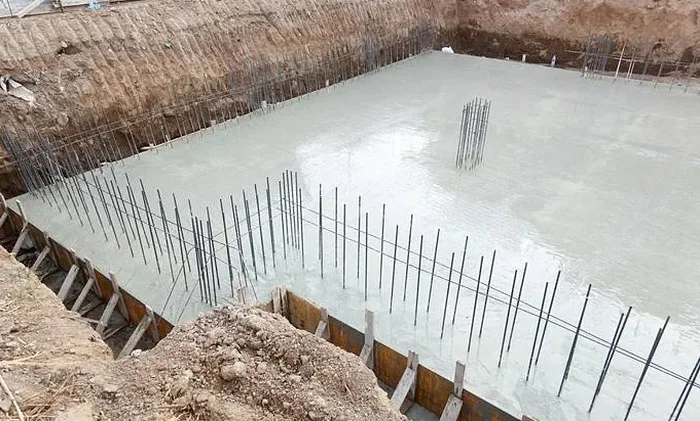
Typical technical challenges in Cleveland
IBC 2021 and ASCE 7-22 require a site-specific investigation when designing shallow foundations on sites classified as Seismic Design Category C or D—which covers most of Cleveland due to the deep soil column over shale. The primary risk is differential settlement caused by variable fill thickness; the Flats and near-east-side neighborhoods often contain demolition debris, buried foundations, and undocumented backfill that create abrupt stiffness transitions. Ignoring these conditions leads to angular distortion exceeding 1/250, cracking partition walls and jamming doors in low-rise buildings. A second risk is perched groundwater in silty layers, which reduces bearing capacity during spring melt. Our field program maps these pockets so the foundation drain system can intercept them before they reach the footing subgrade.
Our services
Our shallow foundation scope for Cleveland projects covers the full design chain, from subsurface characterization to final bearing capacity calculations and construction observation.
Geotechnical Site Investigation
SPT borings, test pits, and laboratory classification to define the bearing stratum and groundwater conditions across the site.
Bearing Capacity & Settlement Analysis
Terzaghi and Meyerhof-based calculations with consolidation settlement prediction for cohesive layers.
Foundation Construction Observation
Proof-rolling subgrade, verifying embedment depth, inspecting reinforcement placement, and confirming soil consistency at footing bottom.
Ground Improvement Design
Evaluation of aggregate piers or rigid inclusions when fill thickness exceeds 6 feet and removal-and-replacement is not practical.
Quick answers
What shallow foundation types work best in Cleveland's glacial till?
Spread footings and strip footings are the most common, typically bearing on stiff clay till at depths of 3.5 to 5 feet. Where the till is thin and overlies compressible lacustrine clay, we often specify a mat foundation to reduce differential settlement. Thickened-edge slabs can work for light-frame residential construction if the subgrade modulus is verified.
How deep must footings be placed to avoid frost heave in Cleveland?
The City of Cleveland and Cuyahoga County enforce a minimum 42-inch embedment below finished grade for exterior footings, measured to the bottom of the footing. Unheated structures may require deeper protection. We confirm this during plan review and field observation.
What does a shallow foundation investigation cost for a typical Cleveland project?
For a standard commercial lot or small subdivision, the investigation and design package runs between US$1,710 and US$2,980, depending on the number of borings, laboratory tests, and the complexity of the bearing analysis. A detailed proposal follows a site walk and review of the architectural plans.
Do Cleveland building officials require a geotechnical report for residential footings?
Yes. The Cleveland Division of Building and Housing requires a stamped geotechnical report for new construction and major additions. The report must include soil boring logs, allowable bearing pressure, and frost-depth compliance per the Ohio Building Code.
How do you handle old urban fill when designing shallow foundations?
We map the fill thickness with SPT borings and, if practical, recommend over-excavation and engineered backfill. When removal is not feasible, we test the fill for compaction and organic content, then design a stiffened mat or consider aggregate piers to bridge the variable material.