Cleveland's lake-effect precipitation saturates the near-surface glacial deposits that blanket much of the city. The weight of new fill or structure loads on these soft lacustrine clays triggers settlement measured in inches, not fractions. We design stone columns to transfer load past the compressible layer into the stiffer till beneath. The Cuyahoga River valley adds buried valley complexity. Our lab runs grain-size distribution on the native clay to confirm fines content before selecting aggregate gradation. Columns typically range from 24 to 36 inches in diameter. Spacing follows the unit cell concept from Priebe's method. For sites near the lakefront with organic silt lenses, we combine stone column design with CPT testing to map the soft zone continuously. This avoids surprises during installation.
A stone column array can reduce total settlement by 40-60% in Cleveland's soft lakebed clays when designed with a Priebe improvement factor above 2.0.
Scope of work in Cleveland
Typical technical challenges in Cleveland
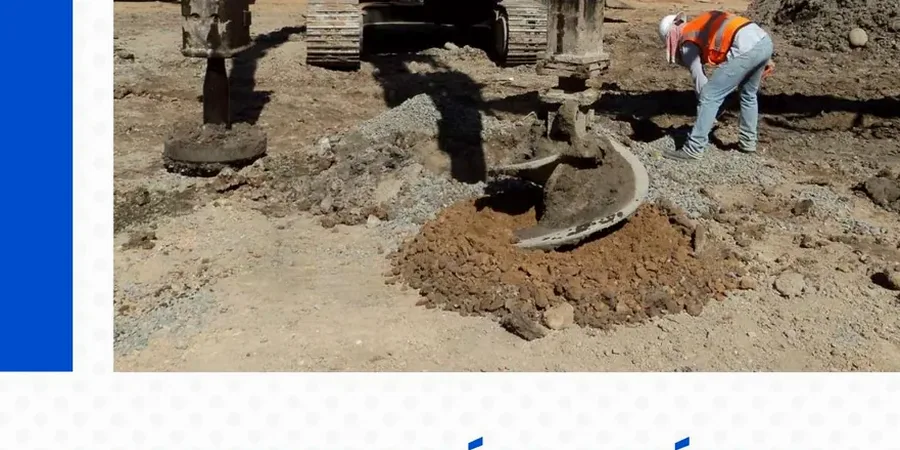
The vibroflot is a bottom-feed cylindrical probe, 12 to 18 inches in diameter, suspended from a crawler crane with a 60 to 80 ft boom. In Cleveland, we mobilize units with electric or hydraulic drive depending on site access in neighborhoods like Ohio City or along Euclid Avenue. The probe penetrates under its own weight plus water jetting. Stone is fed through a hopper and compacted in lifts. The biggest risk in Cleveland's lake plain is uncontrolled lateral displacement toward adjacent structures when columns are installed within 30 ft of existing foundations. We monitor pore pressure with piezometers during installation. A rapid rise signals the need to reduce withdrawal rate. The buried valley also poses differential depth to bearing stratum across short distances. We use seismic refraction surveys to map the bedrock surface before laying out the grid.
Our services
The stone column design package includes field investigation, laboratory testing, and analytical modeling. Each deliverable is specific to the Cleveland site's stratigraphy.
Pre-Design Site Investigation
We drill SPT borings to 60 ft depth across the proposed column grid. Shelby tube samples capture the varved clay structure for oedometer testing. The data feeds the settlement analysis.
Stone Column Analytical Model
We apply Priebe's method and plane-strain finite element models to compute the reduction in settlement under the design bearing pressure. The model outputs column diameter, spacing, and depth.
Load Test Program and QA/QC
We specify the modulus test and full-scale load test per ASTM D1143. During production, we log amperage, lift thickness, and aggregate volume for every column.
Quick answers
What soil conditions in Cleveland warrant stone columns?
Soft to medium stiff lacustrine clays and silts with SPT N-values below 8 blows/ft. These are common in the lake plain and buried valleys of Cuyahoga County. The method works when the undrained shear strength exceeds 15 to 20 kPa.
What is the design life of a stone column installation?
The stone columns themselves are a permanent ground improvement element. With proper filter compatibility between the aggregate and the native soil, the system performs for the life of the structure, typically 50 to 75 years.
How much does a stone column design cost in Cleveland?
A complete design package, including site investigation, laboratory testing, and the analytical report, ranges from US$1.300 to US$4.460 depending on the number of borings and column count.
How do you verify stone column performance?
We run SPT tests within the treated zone 7 to 14 days after installation, plus a full-scale static load test on a production column. The acceptance criterion is settlement less than 1 inch at 200 percent of the design load.
Can stone columns be installed near existing structures?
Yes, but we limit the distance to no less than 10 to 15 ft from existing footings. We use pore pressure monitoring and may pre-drill a relief hole to control lateral displacement during vibroflot penetration.