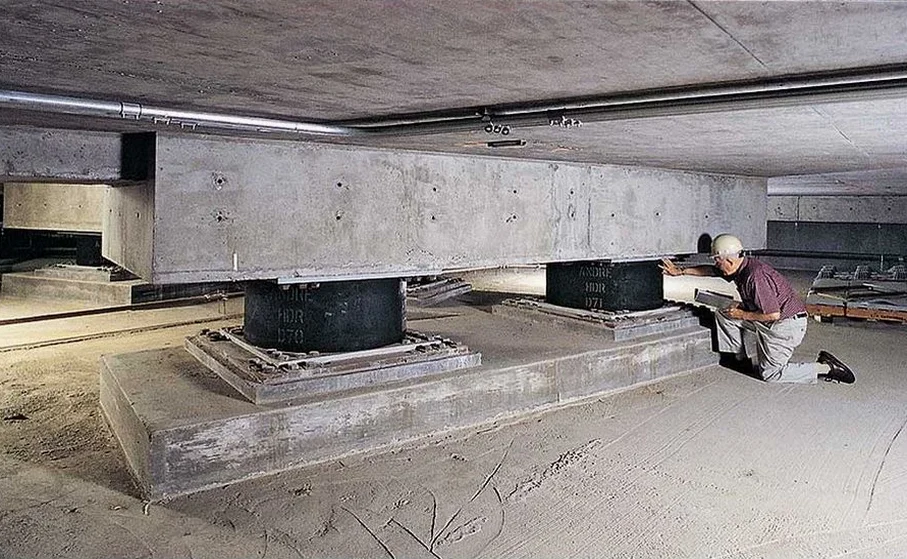
Cleveland's industrial rise along the Cuyahoga River and Lake Erie shoreline left a legacy of dense urban infrastructure on challenging glacial geology. The city sits on a sequence of Pleistocene deposits — stiff silty clays, glacial tills, and lacustrine sediments — that amplify ground motion differently than the bedrock sites common further east. When the 1986 Painesville earthquake (magnitude 5.0) rattled Northeast Ohio, it reminded engineers that the Midwest is not immune to seismic events. For critical facilities, hospitals, and infrastructure in Cleveland, base isolation seismic design shifts the strategy from resisting earthquake forces to decoupling the structure from ground movement entirely. This approach, governed by ASCE 7-22 Chapter 17 and tested against the deep soil profiles of the Erie Lowland, requires a precise understanding of local site response. We combine seismic microzonation studies with advanced isolator modeling to ensure the isolation period falls well outside the predominant period of Cleveland's soft soil columns.
Base isolation in Cleveland targets the amplified 0.5–1.0 second spectral range caused by glacial clay — moving the structure's period to 2.5+ seconds cuts seismic forces by 60 to 80 percent.
Scope of work in Cleveland
Typical technical challenges in Cleveland
The isolator testing protocol we specify for Cleveland projects follows the ASCE 7-22 prototype test sequence: three fully reversed cycles at increasing displacement amplitudes, plus a minimum of ten cycles at the design displacement to verify stability under repeated loading. The test frame applies vertical loads up to 10,000 kN while the horizontal actuator cycles the bearing at velocities representative of seismic excitation — typically 400 to 800 mm per second. Without this level of validation, the risk in Cleveland's soft soil environment is resonant amplification that defeats the isolation effect. A miscalibrated system can produce isolator displacements exceeding the moat clearance, or worse, a period shift into the amplified spectral range that increases rather than reduces interstory drift. The 1986 Painesville event produced peak ground accelerations near 0.05g in downtown Cleveland; a repeat today with an un-isolated essential facility could disrupt emergency response across Cuyahoga County. Isolation design requires nonlinear time-history analysis with at least seven ground motion pairs scaled to the site-specific spectrum, not just the code minimum response spectrum approach.
Our services
Our base isolation engineering covers the full design chain for Cleveland buildings — from initial feasibility through prototype testing and construction oversight. Each phase addresses the specific challenges of the city's glacial stratigraphy and the moderate seismicity of the Eastern Midwest.
Site-Specific Seismic Hazard Analysis
We develop the design spectrum using USGS hazard curves for the Cleveland coordinates, adjusted for site amplification through deep Lake Erie clay. This includes Vs30 profiling via MASW or downhole seismic, dynamic laboratory testing of undisturbed Shelby tube samples, and one-dimensional site response analysis in DEEPSOIL or equivalent software.
Isolator Selection and Nonlinear Modeling
Comparative studies of lead-rubber, high-damping rubber, and friction pendulum systems with bilinear and trilinear hysteresis models. We run the full ASCE 7-22 required analysis set — response spectrum, linear modal, and nonlinear time-history — using ground motions matched to the Cleveland site spectrum.
Prototype Testing Oversight and Construction Review
We prepare the testing specification per ASCE 7-22 Section 17.8, witness the prototype and production tests at the manufacturer's laboratory, and review submittals during installation. Field verification includes isolator leveling surveys, moat wall construction tolerances, and utility crossing detailing to accommodate seismic displacement.
Quick answers
Is base isolation necessary in Cleveland given the low seismicity?
Seismicity in Northeast Ohio is moderate, not negligible. The USGS hazard maps show a 2% in 50-year PGA around 0.06–0.08g on rock, but Cleveland's deep glacial clay amplifies this significantly at periods that match typical building response. For essential facilities — hospitals, emergency operations centers, data centers — base isolation provides functional recovery immediately after an earthquake, which is the performance objective in the latest building code provisions and executive orders for federal buildings.
What does a base isolation design project cost in Cleveland?
For a typical mid-rise building in Cleveland, the engineering design and analysis phase for base isolation ranges from US$3,920 to US$9,520 depending on the complexity of the isolator system and the number of ground motion analyses required. This covers the site-specific hazard study, isolator modeling, prototype testing specification, and construction-phase review. The isolator hardware cost is separate and depends on the number of units and bearing type selected.
How deep do geotechnical borings need to go for isolation design?
In Cleveland, we typically require borings to bedrock refusal. The glacial drift thickness varies from 15 meters near the lakeshore bluffs to over 60 meters in the buried valleys. We need shear wave velocity measurements to at least 30 meters, but for site class determination and site response analysis, confirming the depth to the competent bedrock — usually the Devonian Ohio Shale — is critical for modeling the full soil column amplification.
Can existing buildings in Cleveland be retrofitted with base isolation?
Yes, and several historic structures in the Midwest have undergone isolation retrofits. The process involves temporarily supporting the building on jacking columns, cutting the structural columns at the isolation plane, and inserting the bearings. In Cleveland, the challenge is often the existing foundations on compressible Lake Plain clay — we evaluate the foundation capacity under the concentrated jacking loads and may recommend underpinning or ground improvement before the lift. The moat construction around the perimeter requires careful coordination with adjacent properties and underground utilities common in older Cleveland neighborhoods.