A common misstep we see on Cleveland job sites is treating a 30-foot cut through the Cuyahoga Valley's varved silts the same as a shallow basement dig in the Heights. It isn't, and the difference often shows up as ground loss behind a soldier pile wall or water seeping through an under-designed shotcrete facing. The lacustrine deposits that blanket much of the downtown area can lose significant strength when disturbed, and the weathered shale underneath doesn't always behave like competent rock when exposed to freeze-thaw cycles. Getting the geotechnical design of deep excavations right here means accounting for those transitions early. Before finalizing shoring sections, our team typically correlates stratigraphy from CPT testing with lab shear strength data to avoid surprises at the toe of the wall. In tight urban sites, combining that profile with a careful excavation monitoring plan helps protect adjacent structures from the moment the first lift is removed.
In Cleveland's varved clay, the undrained shear strength can drop by over 40 percent within a few feet of a weathered shale contact — that single interface controls the bracing design.
Scope of work in Cleveland
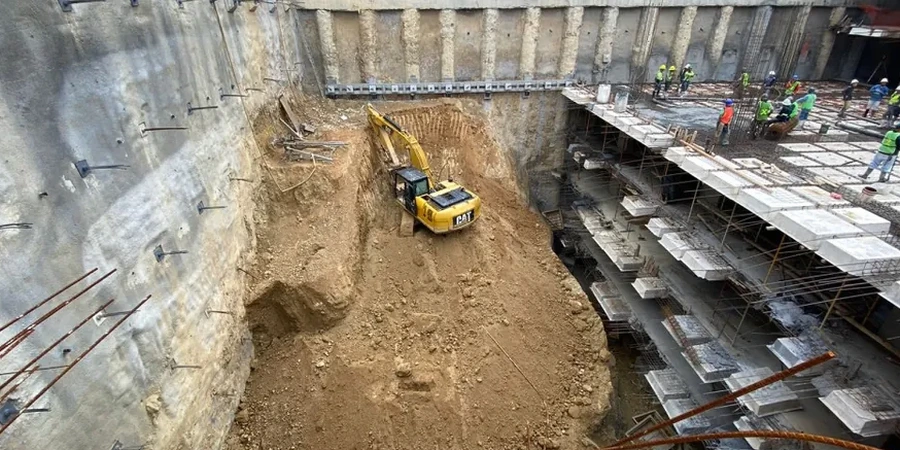
Typical technical challenges in Cleveland
The sharp contrast between Cleveland's humid continental climate and the groundwater regime along the Lake Erie shoreline creates a particular risk for deep excavation design: freeze-thaw cycling in the upper 4 to 6 feet can open cracks in soldier beam lagging, while spring snowmelt raises the water table rapidly behind shoring walls. In the Cuyahoga River valley, the confined aquifer within the granular till often carries artesian pressure, and a single unsealed borehole can flood an excavation within hours. The geotechnical design of deep excavations must therefore incorporate conservative hydrostatic assumptions and staged dewatering, verified against piezometer readings collected during construction. Urban proximity adds another layer of complexity; many downtown Cleveland projects sit within the zone of influence of century-old brick sewers and gas mains, where even small ground movements can trigger utility failures. A solid pre-construction condition survey and movement threshold criteria, tied to instrument readings from inclinometers and optical survey points, are non-negotiable parts of the risk management package our team builds into every shoring submittal.
Our services
Deep excavation projects in Cleveland require more than a generic shoring section pulled from a textbook. The approach we apply integrates local geology, groundwater behavior, and the specific constraints of urban right-of-way.
Anchored and Braced Excavation Design
Complete design of soldier pile and lagging walls, secant pile walls, and diaphragm walls for cuts up to 65 feet deep. Includes finite element modeling of staged excavation with tieback preloading, wale sizing, and corner bracing details. Designs account for Cleveland's layered soil-to-shale transition and comply with FHWA ground anchor load testing protocols.
Dewatering and Seepage Control Plans
Hydraulic analysis and dewatering system design for excavations below the Cuyahoga Valley groundwater table. Covers deep well and eductors layouts, sump sizing, and filter compatibility with varved silt. Plans include monitoring well specifications and contingency triggers for artesian breakthrough in the glacial till aquifer.
Quick answers
What is the typical cost range for geotechnical design of a deep excavation in Cleveland?
For a complete shoring design package — including earth pressure analysis, bracing calculations, dewatering plan, and instrumentation specifications — the engineering fee typically falls between US$1,820 and US$8,590 depending on excavation depth, number of bracing levels, and complexity of adjacent structures. Projects requiring 3D finite element modeling or tieback load testing oversight fall toward the higher end.
Which earth pressure model is appropriate for Cleveland's varved clay?
We typically use the apparent earth pressure diagrams from FHWA-NHI-10-024, calibrated with local case histories. In the stiff, overconsolidated clay zone above the shale, the Terzaghi-Peck envelope for stiff fissured clays often governs. Where the cut intersects weathered shale, we transition to a modified Peck envelope that accounts for the reduced stand-up time of the rock interface.
How do you handle groundwater during excavation in the Cuyahoga Valley?
Groundwater control depends on the permeability of the soil units encountered. In the granular lenses within the glacial till, deep wells with submersible pumps spaced 30 to 50 feet apart are common. In the varved silt, we often specify a jet grout bottom seal or a wellpoint system with vacuum assistance. All dewatering plans include piezometer monitoring and contingency triggers for sudden water level changes.
What instrumentation is required for a deep excavation near existing buildings downtown?
At a minimum, we specify inclinometers behind the shoring wall, optical survey targets on adjacent building facades, and vibrating wire piezometers to track groundwater drawdown. For excavations within 15 feet of occupied structures, we add crack monitors and vibration sensors. The monitoring frequency is tied to excavation stages, with daily readings during active cutting and bi-weekly readings during lag periods.
How does weathered Ohio Shale affect the geotechnical design of deep excavations?
Weathered Ohio Shale presents a dual challenge: it behaves as weak rock with moderate stand-up time when freshly cut, but deteriorates rapidly upon exposure to air and moisture. The geotechnical design of deep excavations addresses this by specifying a shorter unsupported height in the shale zone, applying shotcrete facing immediately after excavation, and reducing the allowable passive resistance at the toe to account for weathering degradation over the construction period.