Cleveland winters are brutal on concrete. The freeze-thaw cycle here is relentless. Lake Erie moisture seeps into the subgrade. It freezes at night. It thaws during the day. This pumps water through every joint. The subgrade shifts. The slab cracks. Rigid pavement design in Cleveland must account for this cycle from day one. The subgrade in much of Cuyahoga County consists of glacially derived silty clays. These soils hold water. They heave when frozen. They soften when wet. A standard design from a southern state will fail here within three seasons. We start by evaluating the subgrade support and drainage conditions. This drives the slab thickness and joint layout. For projects near the Cuyahoga River or on the lakefront fill, we often recommend supplementary in-situ permeability testing to quantify the drainage capacity before finalizing the pavement section.
In Cleveland, the joint is the pavement. Control the joint movement and you control the pavement life.
Scope of work in Cleveland
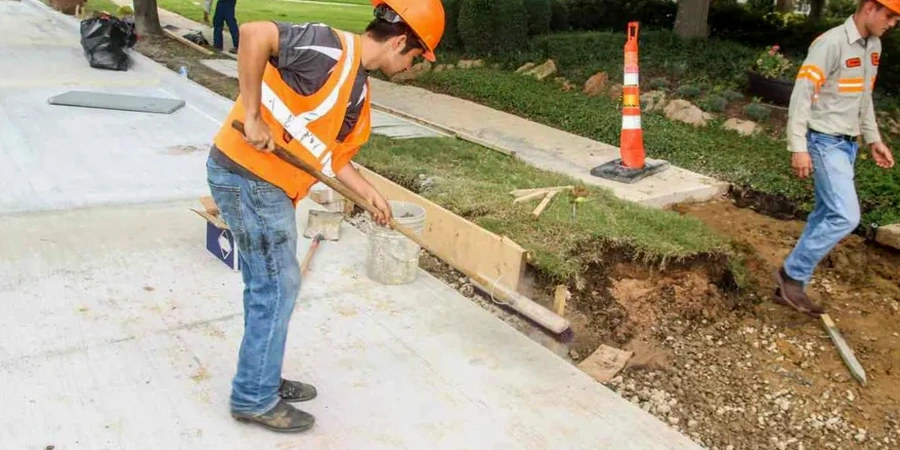
Typical technical challenges in Cleveland
A concrete saw with a diamond blade cuts the contraction joint. The timing of this cut is everything. Cut too early and the aggregate ravels. Cut too late and the slab cracks randomly. In Cleveland's summer heat, the window for sawing can be as short as four hours after finishing. Our field team monitors the concrete set time using ASTM C403 penetration resistance. The saw cut must reach one-quarter of the slab depth. For an 8-inch slab, that is a 2-inch cut. If the subgrade is soft due to a wet spring, the slab edges deflect under the saw. This creates a rough joint face. The joint cannot transfer load properly. The pavement fails from faulting. We mitigate this by specifying a stabilized base course and ensuring positive drainage away from the pavement edge. Standing water at the pavement edge is a failure mechanism we see repeatedly in poorly designed Cleveland parking lots.
Our services
Our rigid pavement design services in Cleveland cover the full project cycle from subgrade evaluation to joint layout and construction oversight.
Subgrade Evaluation
Field CBR and plate load tests to determine the modulus of subgrade reaction (k-value) across the site. We map the variability of Cleveland's glacial soils and recommend targeted undercut or stabilization zones.
Thickness Design
AASHTO and MEPDG analysis using project-specific traffic forecasts and climate data from the Cleveland Hopkins Airport weather station. We optimize the slab thickness and base course section for the design life.
Joint Layout Plans
Detailed jointing plans showing contraction, construction, and isolation joint locations. We coordinate with the structural engineer to avoid random cracking at columns, pits, and transitions.
Quick answers
What is the typical cost range for a rigid pavement design in Cleveland?
The cost for a rigid pavement design package, including subgrade investigation, thickness design, and joint layout plans, typically ranges from US$2,020 to US$6,150. The final cost depends on the total pavement area, the number of soil borings required, and the traffic loading complexity.
Why does Cleveland require air-entrained concrete for exterior pavements?
Cleveland experiences 40 to 60 freeze-thaw cycles per year. Air entrainment creates a network of microscopic voids in the hardened cement paste. These voids provide space for freezing water to expand without cracking the concrete. For exterior flatwork in northern Ohio, this is not optional. It is a minimum durability requirement.
How does subgrade type affect rigid pavement thickness in the Cleveland area?
The modulus of subgrade reaction (k-value) directly controls the required slab thickness. Cleveland's silty clay subgrades typically provide k-values between 100 and 200 pci. Adding a 6-inch aggregate base can increase the effective k-value to 300-400 pci. This reduces the required concrete thickness and lowers the project cost.